

Antibody Name: DCAD2
Antigen:cadherin, DE- (extracellular domain)
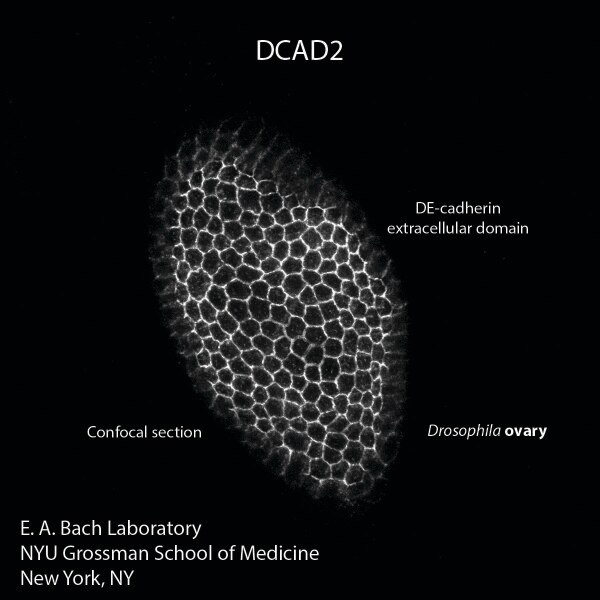
IF of Drosophila ovary stained with DSHB antibody DCAD2 against DE-cadherin. Image credit: E.A. Bach Laboratory, NYU Grossman School of Medicine.
Catalog Fields
Identity
Clone ID / Antibody Name: DCAD2
Alternate Antibody Name: —
Antigen Name: cadherin, DE- (extracellular domain)
Alternate Antigen Name: —
Gene Symbol: —
Gene Name: shg
Entrez Gene ID: 37386
Antigen Sequence: —
Antigen Species: Drosophila
Antigen Mol. Weight: Predicted: 170 kDa; Apparent: 230 kDa [precursor] and 150 kDa [mature form]
Uniprot ID: Q24298
Human Protein Atlas: —
Antibody Properties
Host Species: Rat
Clonality: Monoclonal
Isotype: Rat IgG2a, kappa light chain
Myeloma Strain: P3-X63-Ag8-U1
Antibody Registry / RRID: AB_528120
Available to For-Profits: Yes
Hybridoma Available: Yes
Cell lines cannot be distributed to commercial/for-profit users.
Cell lines cannot be distributed to commercial/for-profit users.
Immunogen & Epitope
Immunogen: Proteins co-immunoprecipitated with an anti-alpha-catenin mAb, DCAT-1.
Immunogen Sequence: Full length protein
Epitope Mapped: Yes
Epitope Location / Seq: Between cadherin repeats 0 and 1
Clone: —
Additional Info: —
Add. Characterization: —
Species Reactivity
Confirmed Reactivity: Drosophila
Predicted Reactivity: —
Depositor
Depositor Name: T. Uemura
Institution: Kyoto Univ. Graduate Sch.of Biostudies
Deposit Date: January 7, 2004
Depositor Notes: Suitable for use in immunostaining and immunoprecipitation. In western blot analysis, DCAD1, another rat monoclonal antibody to DE-cadherin, is more sensitive than DCAD2, although DCAD1 is not appropriate for staining. About requests of DCAD1, please contact Tadashi Uemura (tuemura@lif.kyoto-u.ac.jp). Conditions for immunostaining are described in our papers (Developmental Biology; Genes & Development 10, 659- 671); in addition please note the following comments. 1/ Fixatives (3.7% formaldehyde in PB or 4% paraformaldehyde in CMF & GBS containing 1mM CaCl2). Either fixation protocol works to stain embryos and discs. To stain cultured cells, only the 4% paraformaldehyde condition worked in our hands. We do not prefer any fix solutions including EDTA or EGTA, because cadherin is easily degraded under Ca++- free conditions. 2/ We suspect that the epitope may be sensitive to long exposure to alcohol. So, embryos stored in alcohol may not be stained. 3/ Photos should be taken under confocal microscope. 4/ HRP/DAB reaction has never given clear-cut signals for DE-cadherin at cell-cell contact sites.
Recommended Applications
IF
IHC
IP
WB
Each lab must optimize concentration per application and species. Full usage recommendations →
▼
Could not load UniProt data for Q24298